

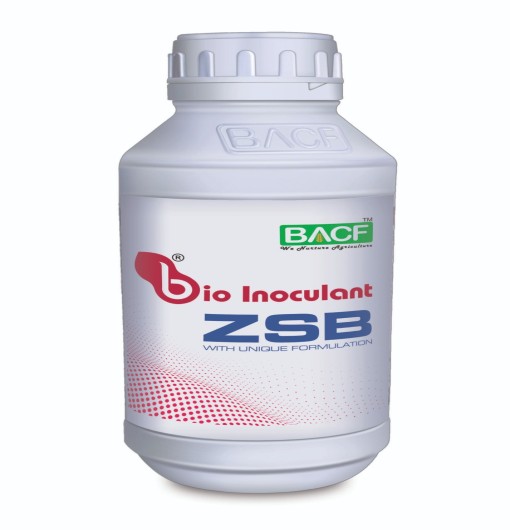
Zinc Solubilizing Bacteria (ZSB)
| Product Type | Fertilizer |
| Form | Liquid |
| Packaging | Bottle and Carboys |
| Size | 1 ltr and 5 ltr |
| Target Crops | All Filed crops and Horticulture crops |
| Target Pest | |
| Mode Of Action | Zinc Solubilization |
BACF Zinc-solubilizing bacteria (ZSB) are a group of microorganisms that play a crucial role in enhancing zinc (Zn) bioavailability in soil, thereby addressing Zn deficiency in crops and improving agricultural productivity. These bacteria convert insoluble forms of zinc into soluble forms, making it accessible for plant uptake.
Composition:
Viable Cell Count: CFU 1 X 10⁸ per ml min.
Contamination level: No Contamination at 105 dilutions
pH: 5.0 to 7.5
1. Importance of Zinc in Agriculture
Zinc is an essential micronutrient for both plants and humans. In plants, it is vital for enzyme activation, chlorophyll synthesis, carbohydrate metabolism, and protein production. Zinc deficiency in crops leads to reduced growth, lower yields, and impaired nutritional quality.
2. Mechanisms of Zinc Solubilization by Bacteria
ZSB employ several strategies to solubilize zinc in the soil:
3. Key Genera of Zinc-Solubilizing Bacteria
Several bacterial genera have been identified for their zinc-solubilizing capabilities:
4. Applications in Agriculture
ZSB are widely used in sustainable agriculture for:
5. Benefits of ZSB in Sustainable Agriculture
6. Recommendation:

At BACF, we endeavor for peoples across world where each person has high nutritional food security; everyone in farming should have satisfying and bring to fruition life. How we do it, here?s how.
+91 8401490651
info@bacf.in; bacfindia@gmail.com

copyright 2020 BACF. All right reserved.