

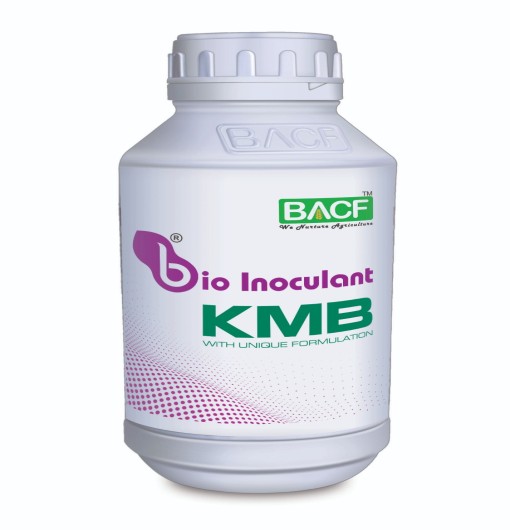
Potassium Mobilizing Bacteria (KMB)
| Product Type | Fertilizer |
| Form | Liquid |
| Packaging | Bottles and Carboys |
| Size | 1 ltr & 5 ltrs |
| Target Crops | All the Field and Horticulture Crops |
| Target Pest | |
| Mode Of Action | Mobilize Potash (K) |
BACF (KMB) are a group of microorganisms that play a crucial role in enhancing the availability of potassium (K) in soil, which is essential for plant growth and development. These bacteria mobilize unavailable form of Potassium to plant mobilizing forms that plants can absorb and move towards growing part of plant.
Composition:
Viable Cell Count: CFU 1 X 10⁸ per ml min.
Contamination level: No Contamination at 105 dilutions
pH: 5.0 to 7.5
1. Mechanisms of Potassium Mobilization
Potassium Mobilizing Bacteria (KMB) employ several mechanisms to solubilize potassium from minerals:
2. Recommendation:
Irrigation:1 litre in one acre
Seed Treatment: Seeds are coated with KMB to promote early root colonization (10 ml per Kg seeds)
Composting: KMB are added to compost to improve potassium content
Saline Soil Reclamation: KMB are effective in improving potassium uptake in salt-affected soils, where sodium (Na⁺) competes with potassium (K⁺) for plant absorption
3. Benefits of Potassium Mobilizing Bacteria
4. Applications in Agriculture
5. Key Genera of Potassium Mobilizing Bacteria
Some of the most studied KMB include:
Conclusion: Potassium Mobilizing Bacteria are a promising tool for sustainable agriculture, offering a natural solution to potassium deficiency in soils. By improving nutrient availability, enhancing crop yields, and mitigating environmental stress, KMB contribute to the goals of eco-friendly and efficient farming. Future research should focus on optimizing their application and understanding their interactions with other soil microorganisms for broader agricultural benefits.

At BACF, we endeavor for peoples across world where each person has high nutritional food security; everyone in farming should have satisfying and bring to fruition life. How we do it, here?s how.
+91 8401490651
info@bacf.in; bacfindia@gmail.com

copyright 2020 BACF. All right reserved.